

Losing important files and data is a stressful situation may happen everyday. In such cases, a data recovery tool is a great helper. Microsoft’s Windows File Recovery is a command-line data recovery tool, designed to help users recover deleted or lost files due to formatting, or files from local storage devices. It may seem like a practical data recovery solution, but many users find it difficult to use due to its command-line interface. In this article, we will take a closer look at how its work and explore another effective alternative.
Part 1: What Is Windows File Recovery?
Microsoft released a free built-in Windows File Recovery for Windows 10 and Windows 11 users. This tool can recover files that have been permanently deleted from local storage. It is useful due to its security and free availability to everybody. However, this tool runs entirely in a command-prompt environment and doesn’t have a graphical interface, which can make it less friendly for beginners.
Here are main features of Windows File Recovery:
- Supported Mutiple File Types and File Systems: DOCX, XLSX, PPTX, PDF, TXT, JPG, PNG, GIF, BMP, MP3, MP4, ZIP, and MPEG and file systems like NTFS, FAT, exFAT.
- Wide Device Compatibility: Internal/external HDD, SSD, USB drives, SD/memory cards.
- Free and Safe: Provided by Microsoft store without any security worry.
- User Interface: Traditional UI without buttons, menus and visual. No file previews functions. Recover data by using command-line.
- Offer Two Scanning Modes: Regular and Extensive Modes are suitable for various data loss situations, such as recently deleted files, formatted drives, and corrupted disks.
Part 2: Before Using Windows File Recovery, You Need to Know
Before using Windows File Recovery, here are several tips for improving the success rate of data recovery:
Stop using the disk immediately: When you notice the files are lost or the drive gets corrupted, do not use the device anymore! Do not attempt to keep moving or saving files to the disk you’re working on.
Start recovery quickly: The earlier you recover data, the better your chances of finding recoverable files.
Recover to a different drive: Save the found files to a different drive and prevent overwriting the original data.
Use /extensive mode when necessary: When your files were deleted some time ago, or the drive has been formatted, corrupted, use /extensive mode. This mode performs a deeper scan for complex data loss situations.
By following these steps, you can reduce the risk of losing data.
Part 3: Where to Download Windows File Recovery?
Download it from the Microsoft Store is the safest way. However, some users cannot access the Store due to regional limits, device restrictions. In that case, you can also look for a Windows File Recovery download without Store. Here are the two common ways to download it.
Option 1. Via Microsoft Store
- Open the Microsoft Store.
- Search for Windows File Recovery.
- Click the Download button next to it.

Option 2. Download from a Third-Party Website
Search for “Windows File Recovery” in your browser. You can find free download options on popular third-party websites such as Uptodown. It can be a practical alternative when the Store is unavailable.
Note:
Download only from trusted third-party websites to avoid viruses or malware on your computer.
Part 4: How to Use Windows File Recovery in Windows 10/11?
Here’s a detailed guide on how to use Windows File Recovery via the command line:
- Press the Windows key, search Windows File Recovery in the search box.
- If prompted by UAC, click Yes to continue running as administrator. Then launch the programn.
- Type a command line in this format according to actual parameters and press Enter:
Winfr source-drive: destination-drive: [/mode] [/switches]
- When asked to confirm, type Y to begin the recovery. The recovery process time depends on the size of your source drive. To stop the recovery at any point, press Ctrl + C.
Here’s some examples:
Regular mode examples:
- Recover your Documents folder from the C: drive to a recovery folder on the E: drive.
Make sure you include the backslash (\) at the end of the folder path.
Winfr C: E: /regular /n \Users\\Documents\ - Recover specific file types, such as PDF and Word files, from your C: drive to the E: drive:
Winfr C: E: /regular /n *.pdf /n *.docx
Extensive mode examples:
- If regular mode doesn’t find what you need, you can try extensive mode. Search for files with “invoice” in the name using wildcard characters:
Winfr E: C: /extensive /n *invoice* - Recover JPEG and PNG images from your Pictures folder and save them to the E: drive:
Winfr C: E: /extensive /n \Users\\Pictures\*.JPEG /n\Users\
Part 5: Windows File Recovery Review
Here are real users comments on the Microsoft Store, read those if you want to learn more:
“Not having a GUI is just plain lazy by today’s standards.”
“Just removed some documents by accident, and used this tool to recover. It’s really useful and convenient. Thanks!!!”
“I did a couple tests with this, and it turns out that if you have a basic text file that has been deleted within the past day or so, the software works. But more complex files (pictures, audio, video) will be “recovered” but unreadable/corrupt.”
What people like:
- Free to use
- Safe and official tool from Microsoft
- Supports two recovery modes
- Works reasonably well for basic NTFS recovery
What people dislike :
- No graphical (GUI ) user interface and no preview feature
- Recovery results can be inconsistent
- Limited advanced features compared with third-party software
Windows File Recovery reviews are mixed. Even when they follow Microsoft’s instructions, many still encounter issues such as empty results, corrupted files, or output that cant be use. It triggers a large number of them to quickly turn to effective alternatives.
Part 6: Better Alternative to Windows File Recovery
If Windows File Recovery feels too complex, a more user-friendly alternative is iToolab RecoverGo Windows Data Recovery. Unlike Microsoft’s command-line tool, iToolab RecoverGo Windows Data Recovery has a user-friendly interface and recover data in just a few step, which makes it easier for beginners to get started.
Main Features
- Simple and fast recovery steps: Recover lost data in just a few clicks—select, scan, and recover.
- 99% High success rate: Advanced algorithms guarantee a high recovery rate and greatly improve your recovery efficiency.
- Preview files before recovering: Before final recovery, users can check the results and recover the files, saving time and improving accuracy.
- Search and filter recovered data: Help users locate target files more quickly after scanning.
- Supports 1000+ file types and 2000+ devices: Recover important photos, videos, documents, audios from hard drive, sd card, USB flash drive, and more.
- Works in various data loss situations: Such as accidental deletion, emptied recycle bin, physical damage, virus or malware attacks, formatted hard drive.
How to Recover Permanently Deleted Data with iToolab RecoverGo?
Step 1 Select a Location: Select a location where you lost files. Then click the “Search for Lost Data” button.

Step 2 Scan Your Drive: Start the scan to search for deleted or lost files on the selected location. The recovery rate can be increased with quick scan and advanced scan.
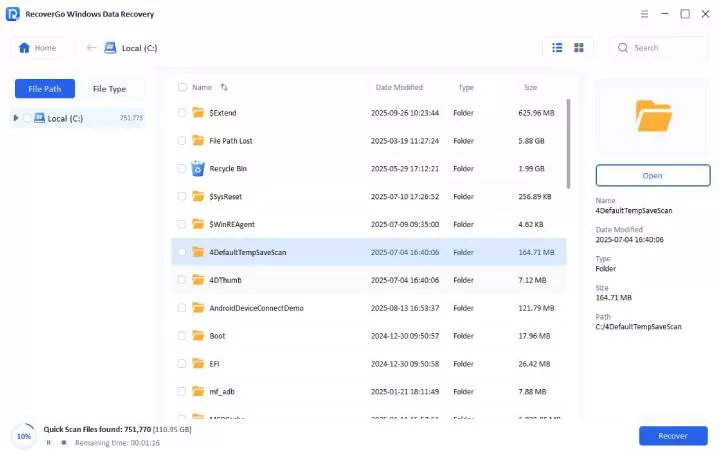
Step 3 Preview and Recover Your Data: Click the “Preview” button to check the found files and then click the “Recover” button to recover it.

FAQs About Windows File Recovery
Is Windows File Recovery free?
Yes, Windows File Recovery is a free command-line tool for recovering data without any charge.
Is Windows File Recovery safe?
Yes, Windows File Recovery is officially provided through the Microsoft Store, which ensures it is free from malware risks.Does Windows File Recovery really work?
Yes, Windows File Recovery can work well in some situations, especially when files were deleted recently and the drive has not been heavily used afterward. However, the recovery result depends on whether deleted data has already been overwritten, damaged and so on. That is also why many users prefer a more user-friendly alternative.
In Conclusion
Overall, Windows File Recovery is still worth trying. It is functional and useful for those who have command-line knowledge. However, for users who lack technical skills and prefer a simpler workflow, iToolab RecoverGo Windows Data Recoverycan be a better alternative. Download it for a faster and easier way to recover your lost data.