

One major disadvantage of Windows File Recovery (Winfr) is the lack of a GUI. WinfrGUI claims to solve this issue by adding a GUI on top of Windows File Recovery.
According to the developers, the software is powered by Microsoft’s Winfr recovery engine. But can you really trust WinfrGUI, and does it actually work?
In this complete WinfrGUI review, we will look at its key features, real-world performance, and what actual users have to say. We’ll also compare it with a more powerful alternative to help you make the right choice.

Part 1: Quick Summary of WinfrGUI
The original Winfr (Windows File Recovery) is offered by Microsoft. However, it has a rating of 2.8/5.0 on the Microsoft Store. Why? Because it is a command-line tool and very difficult to use.
WinfrGUI fixes this by offering a GUI version. The presence of a GUI makes it easy for everyday users to recover data with Windows File Recovery.
It is worth mentioning that WinfrGUI uses the Windows File Recovery CLI as its foundation. So, it is just Winfr under the hood but easier to use.
WinfrGUI is made by AOMEI, not Microsoft. It is a software company that offers different data recovery and system management tools. Some users may confuse it with a Microsoft product, but it’s actually a third-party GUI wrapper.
Key Features of WinfrGUI
User Interface
The interface is simple and shows all the options on the same page.
A list of all the available storage devices is shown on the main screen. From here, a user can select which partition to scan. The page also has an option to select a scan type and where to save restored files.
When compared with Windows File Recovery, WinfrGUI is definitely an upgrade in terms of usability.
File Types and File System
WinfrGUI supports all the common file types. It covers commonly used file types in different categories including images, videos, documents, compressed archives, and more.
The tool works best with the NTFS file system. It can also be used with FAT, exFAT, and ReFS. But the recovery results are not as reliable as with NTFS.
So, it is not recommended for flash drives or SD cards. Why? Because these devices usually run on exFAT or FAT32.
Scanning Modes
WinfrGUI offers two scanning modes:
- Quick scan: Fast but only supports NTFS. Retains original filenames and folder structure.
- Deep scan: More thorough and works for non-NTFS drives. Takes more time, and recovered files lose original names.
There’s also an option to find files based on a specific file type or extension. A user can also specify a specific folder to search for the lost files.
Who Should Not Use WinfrGUI
- Recover files from USB drives or memory cards.
- Recover data from formatted or RAW drives.
- Advanced users requiring precise file-type recovery.
Part 2: How to Use WinfrGUI?
The simple user interface makes it easy to use this software. Here’s how:
- Install and launch WinfrGUI. From the main screen, select a drive for the scan.
- Then select the scanning mode and where to save the data. You can click on “Advanced settings” to search for a specific folder or file type.
- Click on “Start Recovery” to initiate the scan. The software will start to scan and recover any deleted files it finds on the drive.
- Once the process is complete, check the destination folder to view the recovered files.


Part 3: Does WinfrGUI Work? Real Tests
To test the software’s capabilities, we used a 16 GB flash drive (NTFS). We tested it against two scenarios:
Test 1: Recently Deleted Files
It took around 2 minutes to scan and recover data from the pen drive. We used the quick scan mode, as it is faster enough for recently deleted files.
WinfrGUI managed to recover 630 out of 700 files. This puts its recovery rate at 90% for simple recovery tasks. That’s quite reasonable given that it is a free tool.
Test 2: Quick Format
This test took 15 minutes to complete (scanning and recovery). As this was a more complex scenario, the software only recovered 588 out of 700 files.
This puts the recovery rate at 84%. The recovered files lost their original names and folder structure.
Test Summary:
Verdict:
The average recovery rate is 87% for NTFS-based storage drives. However, performance drops when you switch to non-NTFS file systems. In fact, the software can also crash sometimes when scanning FAT32 or exFAT partitions.
With all things considered, WinfrGUI only performs best with NTFS-based drives. Its performance takes a hit in more complex data loss scenarios.
Part 4: Real User Reviews of WinfrGUI
WinfrGUI has a rating of 4.2/5.0 on the Microsoft Store. The software’s rating on Trustpilot is 3.2/5.0. So based on these two sources, the average rating of WinfrGUI is 3.7/5.0.
What Users Like
- Easy to use with no complex commands
- Completely free with no hidden costs
- Lightweight with portable version available
- Simple and straightforward recovery process
What Users Don’t Like
- Low recovery rate in complex situations
- Recovered files lose original filenames and folder structure
- Poor performance on FAT32 and exFAT drives
- Software crashes during recovery process
- No file preview feature
Real User Reviews:
Sam Said:
“I used WinfrGUI to recover recently deleted files. However, the scan process got terminated. The tool also created a recovery folder with irrelevant files. Now, I can’t even delete the folder generated by it. Not recommended!”
Daniel Said:
“I deleted a bunch of text files on a local partition. WinfrGUI only managed to recover 40 out of 50 files.”
Lucas Said:
“WinfrGUI is easier than Windows File Recovery. However, I noticed it only works best with NTFS. I wish they could improve the support for FAT32 and exFAT.”
Morgan Said:
“The recovered data had weird names and no folder structure. I had to spend 30 minutes to find the file I wanted.”
Part 5: Better Alternative to WinfrGUI🔥
WinfrGUI is a good free option for basic file recovery. However, it lacks advanced features and has an average recovery rate.
A more powerful alternative is iToolab RecoverGo Windows Data Recovery. It can easily handle various data loss situations including deletion, formatted drives, RAW drives, and more.
WinfrGUI is just a graphical wrapper for Microsoft’s Winfr. However, RecoverGo is a complete recovery solution. It supports all known file systems (NTFS, exFAT, FAT32, and more) and 1,000+ file types.
Key Features of RecoverGo:
- 99% recovery rate: Advanced algorithms ensure a higher recovery rate.
- Fast scanning speed: Quick scans with minimal memory usage, recovering files from exFAT drives in just minutes.
- File preview: Preview files before recovery to ensure quality.
- Support 2000+ devices: Recovering files from hard drives, USB drives, SD cards, or memory cards, and more.
- Preserve original names: Preserves file names and folder structure.
How to Use RecoverGo:
Step 1 Launch the software. Select a location and click on “Search for lost data”.

Step 2 Wait for the scan to complete. Use the built-in filters to find specific files.
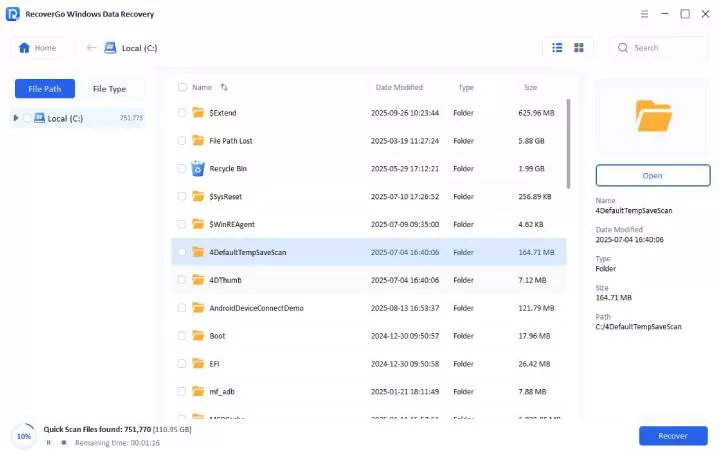
Step 3 Preview the files and click “Recover” to restore them to a safe location.

FAQs About WinfrGUI
Is WinfrGUI completely free?
Yes, WinfrGUI is completely free to use with no hidden costs or premium versions. It’s developed by AOMEI as a free GUI wrapper for Microsoft’s Windows File Recovery tool.
Is WinfrGUI the same as Windows File Recovery?
Not exactly. WinfrGUI uses Windows File Recovery as its underlying engine, but adds a graphical user interface on top. The core recovery technology is the same, but WinfrGUI makes it easier to use without command-line knowledge.
Also Read: Windows File Recovery Stuck at 99%? Here’s How to Fix It Fast
Why does WinfrGUI lose file names on non-NTFS drives?
Windows File Recovery (the engine behind WinfrGUI) uses a signature-based scanning method for non-NTFS file systems. This method identifies files by their content patterns rather than file system records, which means original file names and folder structure cannot be preserved.
Can WinfrGUI recover files from SD cards?
WinfrGUI can recover files from SD cards, but with limitations. Most SD cards use exFAT or FAT32 file systems, where WinfrGUI’s performance drops significantly. For SD card recovery, a tool like RecoverGo that supports all file systems equally is recommended.
Conclusion
WinfrGUI has the same limitations as Windows File Recovery. The only difference is that it has added a GUI wrapper on top of Microsoft’s Winfr tool.
It is a free tool and works okay for simple recovery tasks on NTFS drives. But it lacks file preview support, and the recovery rate is just average at 87%. The biggest drawback is poor support for non-NTFS file systems.
iToolab RecoverGo Windows Data Recovery is a far better option. It has a modern interface, uses advanced scanning technology, and achieves a 99% recovery rate. The best part? RecoverGo works equally well with all common file systems, such as NTFS, exFAT, FAT32, and more.