

DiskDigger is a portable data recovery tool. The software claims to recover data from hard drives, USB flash drives, and other storage devices.
But can you trust it with recovering your important files? Is it the right choice for your data recovery needs?
In this complete DiskDigger review, we will explore its features, pricing, real-world test results, and user feedback. We’ll also compare it with a modern alternative to help you make a wise decision.

Part 1: DiskDigger Overview
DiskDigger for Windows is lightweight and portable. It is ideal for everyday users who want to undelete files. The software handles simple recovery tasks well.
However, DiskDigger struggles in complex data loss situations. The success rate drops on RAW partitions, formatted drives, and similar scenarios.
The user interface looks outdated. There is no option to scan a specific partition or folder—you must scan the entire drive. This makes the process time-consuming.
Key Features of DiskDigger
File System and OS Support
DiskDigger supports common Windows file systems:
- exFAT, NTFS, FAT16/FAT32, ReFS
This covers most storage devices you’ll encounter. The software also supports both old and new Windows versions: Vista, 7, 8, 10, and 11. Both 32-bit and 64-bit systems are supported.
File Type Support
DiskDigger supports common file types in these categories:
- Images (JPG, PNG, GIF, etc.)
- Audio and video (MP3, MP4, etc.)
- Documents (DOC, PDF, etc.)
- Compressed archives (ZIP, RAR, etc.)
It also supports other file types such as ISO, EXE, WALLET, and XAC. Overall, the tool supports common file types.
However, this lags behind modern tools. Most modern recovery software supports 1,000+ file types. For everyday users, DiskDigger’s 128+ file types may be sufficient.
User Interface
The user interface is simple but outdated. It feels like Windows 7 era software.
The main screen shows all connected devices: HDD, USB drives, memory cards, etc. To start a scan, select a drive and click Next. You’ll then choose which file types to scan.
The biggest flaw? The software doesn’t show partitions. You must scan the entire drive instead of a specific partition or folder.
Pros
- Portable (no installation needed)
- File preview available
- Disk image scanning supported
- Lightweight and runs on older systems
Cons
- Outdated user interface
- Weak performance in complex cases (format, RAW drive)
- Scanning takes a long time
- Cannot scan specific partitions—only entire drives
Is DiskDigger Free?
DiskDigger offers a free version that allows you to scan and preview files. However, when you try to recover files, a pop-up encourages you to purchase the paid version ($14.99). You can still recover files without paying, but the pop-up will appear each time.
Part 2: How to Use DiskDigger for Windows
Make sure to download DiskDigger.exe only from the official website, as cracked versions may contain malware and pose a risk to your system. Now, let’s walk through how to use the DiskDigger PC version.
Step-by-Step Guide:
- Download and launch DiskDigger. The main screen shows all connected storage devices. Select a drive and click Next.
- Select specific file types or scan for all file types. Click Next to start scanning.
- Files appear in real-time during the scan. Then select a file to preview and choose “Recover selected files.”


Tips to Improve Recovery Rate:
- Do not restore files to the original disk.
- Act as soon as possible—delaying increases overwriting risk.
- Do not format the drive before recovery.
- Always use reputable data recovery software.
Does DiskDigger Recover Permanently Deleted Photos?
Yes, DiskDigger can recover permanently deleted photos—depending on the drive condition and whether data has been overwritten.
In simple data loss situations, photos are usually recoverable. However, DiskDigger struggles with complex scenarios like RAW drives or formatted disks.
Part 3: Real User Reviews of DiskDigger
DiskDigger has a 3.8/5.0 rating on Trustpilot and 3.9/5.0 on CNET. The aggregate rating is 3.85/5.0—suggesting users view it as an average data recovery tool.
What People Like
- Lightweight and requires no installation.
- Preview feature works well.
- Free to use (with pop-ups).
- Runs on older Windows systems.
What People Don’t Like
- Cannot handle complex recovery scenarios.
- Recovery rate drops with formatted drives or corrupted partitions.
- Slow scan speeds.
- Outdated interface.
- Cannot scan specific partitions.
DiskDigger Real User Reviews:
Seth Said:
“Scans are very slow. I only wanted to recover data from one partition, but it scanned the entire HDD and took 2 hours. It doesn’t let me select one partition.”
David Said:
“The software found 150 deleted files but only recovered 60. It’s okay but could be improved.
Emma Said:
“The preview feature is very good. It helped me confirm which documents to restore.”
Sarah Said:
“It only recovered 20% of the files from my RAW USB drive. Not recommended.”
Part 4: DiskDigger Performance Test Results
We tested DiskDigger in different scenarios to see how it performs:
Test1: Deleted Files
We deleted files on a 32 GB flash drive (NTFS). DiskDigger recovered approximately 64% of the data. However, folder structure was lost, and most files had generic names.
Test 2: Quick Format
We performed a quick format on the same 32 GB USB. DiskDigger struggled—the effective recovery rate was only 40%. It recovered 240 out of 600 files.
Scan Speed
It took approximately 50 minutes to scan the 32 GB flash drive. This is slower than most other tools, which can scan the same drive in under 20 minutes.
Test Summary:
What Is the Success Rate of DiskDigger?
Our tests show DiskDigger has an average recovery rate of 52% across both scenarios. This demonstrates that DiskDigger is not reliable for serious data loss situations. If you’ve lost important files, consider a more capable alternative.
Part 5: Better Alternative to DiskDigger🔥
Slow scan speed and low recovery rate are DiskDigger’s key drawbacks. If you need something faster with a higher success rate, try iToolab RecoverGo Windows Data Recovery.
RecoverGo is modern data recovery software. It handles both simple and complex data loss cases. What’s impressive is its 99% recovery rate. The scanning speed is also much faster than DiskDigger.
Key Features of iToolab RecoverGo:
- Modern interface: Clean, user-friendly design.
- Fast scan speeds: Scan drives in minutes, not hours.
- 1,000+ file types: Supports all common file formats.
- 2,000+ devices: Works with SD cards, USB drives, HDDs, SSDs, and more.
- Preview feature: Preview files before recovery to ensure quality.
DiskDigger vs iToolab RecoverGo:

iToolab Special Coupon
20% OFF iToolab coupon code for data recovery tool
How to Use RecoverGo:
Step 1 Install RecoverGo on your computer. Then select the drive you want to recover data from. Click “Search for lost data” to start the scan.

Step 2 Start the scan to locate deleted or lost files. After scanning, use filters to narrow down results by file type. You can also search by file name.
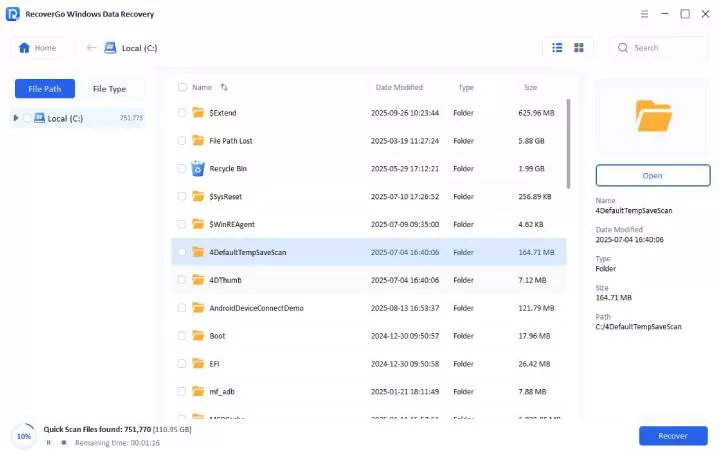
Step 3 Preview the found files. Then select the files you need and click “Recover.” Choose a safe location (not the source drive) to save your recovered data.

Part 6: FAQs About DiskDigger
Is DiskDigger safe to use?
Yes, DiskDigger is safe if downloaded from the official website. The software uses read-only mode during scanning, so it won’t overwrite your existing data. Avoid downloading cracked versions from third-party sites, as they may contain malware.
Why is DiskDigger scan so slow?
DiskDigger scans the entire drive rather than specific partitions, which increases scan time significantly. Additionally, it uses older scanning algorithms that are not as optimized as modern recovery tools. For faster scanning, consider alternatives like RecoverGo.
Can DiskDigger recover files from a formatted drive?
DiskDigger can recover some files from a quick-formatted drive, but with a low success rate. Our tests showed only a 40% recovery rate after quick format. For formatted or RAW drives, a more powerful tool like RecoverGo is recommended.
Conclusion
DiskDigger is a great recovery tool for basic tasks. You can use it to recover a few images or documents from storage devices. The portable nature and low price point make it accessible for simple needs.
However, it is not built for complex data loss scenarios like formatted drives, RAW storage, or corrupted data. The 52% average recovery rate and slow scan speeds are significant drawbacks.
A better option is iToolab RecoverGo Windows Data Recovery. It has a 99% recovery rate, fast scanning algorithms, and can handle both simple and complex data loss situations. The modern interface and preview feature make recovery easy for anyone.