

I was cleaning up my desktop just yesterday and i accidentally deleted one of my folders containing my artwork files. Can i get these folder back?
— From Reddit Community
Have you ever experienced cleaning up your PC and ending up with missing folders? There are several reasons why folders get deleted from your device. A comment on Reddit highlighted the issue of accidentally deleting files from the desktop, presuming them to be shortcuts.
Research done at Cornell University shows that more than 60% of drives have the files that users assumed were missing. However, you need to use the right data recovery method. This guide covers all the ways on how to recover a deleted folder on Windows 10 and 11 effectively.
Part 1: Can You Restore a Deleted Folder in Windows?
You can get a recently deleted folder back if you have not added new data to the drive. However, several factors affect whether recovery is possible. The table below explains common scenarios, recovery chances, and the key factors that affect whether files can still be recovered.
Part 2: How to Recover a Recently Deleted Folder in Windows?
If you have just deleted a folder, you can recover it without data recovery software. Windows comes with several built-in recovery options to recover deleted folders. Here is how to recover a deleted folder in Windows, starting with the simplest methods.
Method 1: Undo the Deletion
The Undo command is a quick method for recovering a folder that has been deleted recently. This method is effective right after the folder is deleted and before any other actions are performed on the system.
Guide to Undo:
- Open the location of the deleted folder and right-click to choose Undo Delete.
- You can also use the Ctrl + Z keys to recover the folder.

Method 2: Restore the Folder from the Recycle Bin
Deleted folders are not immediately erased and are usually stored in the Recycle Bin first. They can be quickly restored with a few clicks as long as the Recycle Bin has not been cleared.
How to Proceed:
- Launch the Recycle Bin.
- Right-click the folder that you want to recover.
- Click Restore to recover it to its original location.

Part 3: How to Recover a Permanently Deleted Folder in Windows?
If your folder was not in the Recycle Bin or you already emptied it, do not worry. It may still be recoverable. The system marks that space as available, so the folder can often still be recovered before new data overwrites it.
- Method 1: Restore from File History
- Method 2: Recover from Cloud Backup
- Method 3: Try Windows File Recovery
- Method 4: Use Advanced Folder Recovery Software
Method 1: Restore Folder from File History
File History is a built-in Windows backup feature that automatically saves copies of files and folders over time. If it was enabled before deletion, you can use it to restore previous versions of your missing folder.
Here are the steps:
- Make sure File History is enabled on your PC.
- Go to Control Panel > System and Security > File History.
- Select Restore Personal Files on the left side to access missing folders.
- Find your deleted folder, select it, and tap the Restore icon to recover it.

Method 2: Recover Folder from Cloud Backup
No luck with File History? Your folder might still be recoverable through cloud storage. When you delete a folder, you can recover it from the cloud as long as it was synced before the deletion.
Guide to Recover from Cloud Backup:
- Navigate to My Drive in Google Drive.
- Search for the deleted folder.
- Select the folder and click the Three Dots icon.
- Use the Download option to download the deleted folder.

Method 3: Try Windows File Recovery
Windows File Recovery is a command-line utility developed by Microsoft that can scan storage drives and attempt to recover permanently deleted files and folders. It is effective only immediately after deletion and if the drive has been used very little.
Not to mention that the tool is run via Command Prompt, which can be difficult for people who are not accustomed to commands. Deep scans often result in fragmented or reorganized data.
Follow the steps below:
- Download Windows File Recovery from the Microsoft Store and run it as an administrator.
- Use a command like the one below. Replace C: with the drive where the folder was deleted, and E: with a different destination drive. Such as: winfr C: E: /regular /n \Users\YourName\Documents\DeletedFolder\
- If Regular mode does not find the folder, try the Extensive mode: winfr C: E: /extensive /n \Users\YourName\Documents\DeletedFolder\
Now, wait for the scan to complete and then check the destination drive for the recovered files.

Method 4: Use Advanced Folder Recovery Software – Easier and Quicker
If the built-in tool did not work or felt too technical, here is a simpler option to try. Looking for a missing folder on your device is simple, but it gets harder when the folder is no longer accessible.
For users who find command-line tools challenging, iToolab RecoverGo Windows Data Recovery offers a more approachable alternative. This software is a tested tool that can recover folders deleted using the Shift + Delete method with a 99.7% success rate.
It can recover files after system crashes, accidental deletion, formatted drives, and other data loss situations. It also lets you search for required files more efficiently by using filters such as file type, file location, and last modified date. You can pause and resume the recovery process at any time.
Key Features:
- Supports folders containing photos and many more file types.
- Lets you preview recovered folders before saving them.
- Recovers a whole folder structure rather than only individual files.
- Recovers data from hard drives and 2,000+ other devices.
Quick Guide for Folder Recovery Using iToolab RecoverGo:
The RecoverGo interface is easy to use and recovers your folders in 3 simple steps. Follow this guide and learn how to recover a permanently deleted folder in Windows 11 using this tool.
Step 1 Select the Drive for Folder Recovery
Open RecoverGo on your device and select the drive that last had your missing folder. After locating the drive, select the Search for Lost Data button to continue.

Step 2 Scan the Device to Locate the Folder
The tool will run a scan across your device to find the missing folder. You can also use Quick Scan, Deep Scan, and Advanced Scan to locate the folder faster.
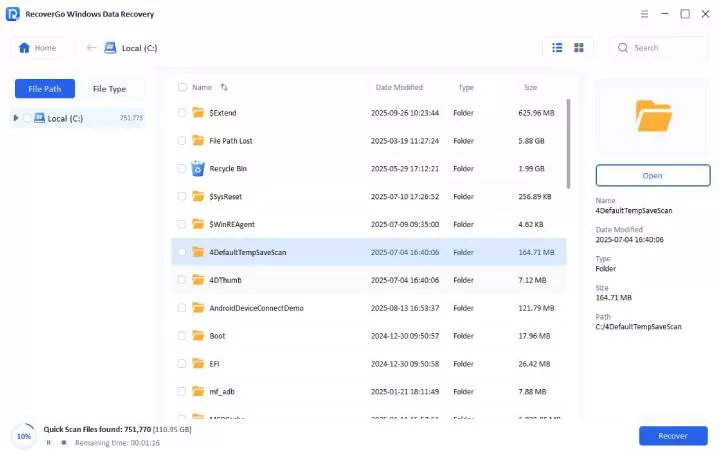
Step 3 Save the Recovered File After Previewing
Once the files have been found, preview them and click Recover to select the folder where you want to save them.

Part 4: How to Prevent Folder Loss in the Future?
Once your folder is back, it is worth taking steps so you do not have to go through this again. With proper backup plans and some built-in tools in Windows, there is a great possibility of preventing data loss permanently.
Enable File History
File History is one of the simplest ways to back up your files in Windows. It saves a copy of your folders automatically once it is enabled and lets you go back to previous versions if necessary.
Instructions:
- Connect an external drive or select a network location for backups.
- Open the File History window from Control Panel.
- Click Turn On to enable File History.
Create Regular Backups
Regular backups protect your files in case of accidental deletion or system failure, giving you a safe copy to restore from. You can manually copy files to an external drive weekly or monthly. Cloud storage services can also be set to automatically sync your files. Keep multiple backup copies so your data is safe even if one backup is accidentally overwritten.
Final Words
Deleting folders on Windows does not always mean they are gone forever. With a few simple steps, you can know how to recover a deleted folder. Windows offers several built-in recovery tools and backup options you can use.
On the other hand, iToolab RecoverGo Windows Data Recovery helps you bring back deleted folders from formatted drives, inaccessible drives, and other difficult data loss situations. This tool takes most of the guesswork out of recovering a deleted folder.