

I accidentally saved over an important Word document. I had been working on this file for weeks and now all my work is gone. Is there any way to recover an overwritten Word file on Windows 10?
— From Microsoft Answers
Accidentally overwriting a Word document is a frustrating experience. Whether it’s a thesis chapter, a client proposal, or an important report, the loss can feel devastating. But here’s the good news: recovery is often possible.
When you overwrite a file, Windows doesn’t immediately erase the old data. Instead, it marks that space as available for new data. The original content may remain on your drive until something else writes over it.
In this guide, we will show 4 proven methods to recover overwritten Word files on Windows 10 and Windows 11. We’ll also cover how to prevent data loss in the future.
Part 1: Can You Really Restore Overwritten Word File?
In many cases, an overwritten Word document can still be recovered. However, the chances of success depend on several important conditions:
Part 2: How to Recover Overwritten Word File via Windows Built-in Tools?
Windows includes several built-in recovery options for overwritten files. These methods work by restoring previous versions of your file from system backups.
- Method 1: Use Previous Versions Feature
- Method 2: Windows Backup and Restore
- Method 3: Use Cloud Backup
Method 1: Use Previous Versions Feature
Windows File History and System Protection create snapshots of your files. If enabled, you can restore earlier versions of your document—even after it’s been overwritten.
You can try the following steps:
- Right-click the overwritten Word file and select “Properties.”
- Go to the “Previous Versions” tab. You’ll see a list of saved versions with timestamps.
- Select a version from before the overwrite. Click “Open” to preview the content.
- If it’s the correct version, click “Restore” to replace the current file.

Method 2: Windows Backup and Restore
Windows includes a Backup and Restore feature (different from File History) that creates full system backups. If you configured this before the overwrite, you can restore your document from the backup.
Following these steps to recover overwritten files:
- Open Control Panel → “Backup and Restore (Windows 7).”
- Click “Restore my files.”
- Browse for your Word document or search by filename.
- Select the file and choose a location to restore it.

Method 3: Use Cloud Backup
If your Word document was stored in OneDrive, you can restore previous versions through the version history feature—even if you didn’t manually enable backups.
OneDrive automatically stores version history for Office files, allowing you to restore previous versions even after overwriting.
Try the following solutions to restore overwritten files:
- Go to OneDrive.com and sign in with your Microsoft account.
- Navigate to the folder containing your overwritten file.
- Right-click the file and select “Version history.”
- Select a version from before the overwrite and click “Restore.”

Part 3: How to Recover Overwritten Word File Using Professional Software?
When built-in tools don’t work, iToolab RecoverGo Windows Data Recovery offers another option. This software scans raw disk data to locate recoverable file fragments. In some cases, parts of the original file can still be found in unallocated disk space if they haven’t been fully overwritten.
Key Features:
- Three scan modes: Searches unallocated disk space for file fragments.
- Wide format support: Supports 1,000+ file formats, including DOCX and DOC files.
- High success rate: Advanced algorithms ensure a 99.7% recovery rate.
- Multiple devices: Works with 2000+ internal drives, external USB drives, SD cards, and corrupted partitions.
- Simple 3-step process: Recover Word files in just a few clicks.
How to Recover Overwritten Word File with RecoverGo:
Step 1 Download and install RecoverGo on a different drive (not the one containing your lost file). Launch the software and select the drive where your Word file was stored. Then click “Search for Lost Data”.

Step 2 The software starts scanning. If you remember the file name, you can use the file filter to narrow results.
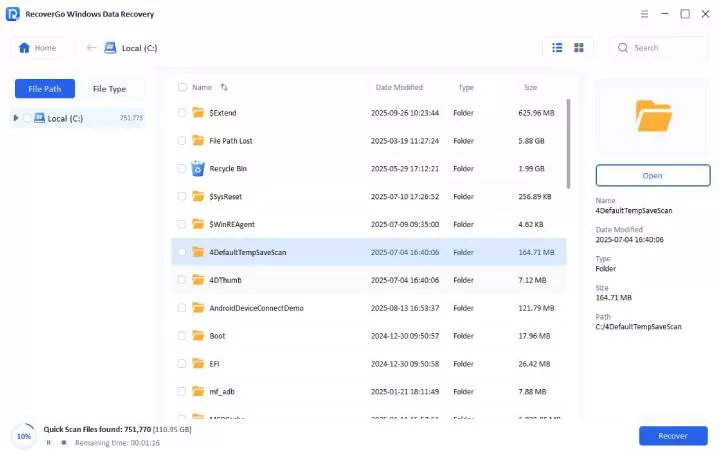
Step 3Select the files you need and click “Recover.” Then you can save them to a different drive to avoid overwriting.

Part 4: How to Prevent Files from Being Overwritten?
Preventing file overwrites is always easier than trying to recover them later. Implement these habits to protect your work:
Maintain Regular Backups
Keep multiple copies using external drives or backup tools, so you always have a fallback copy even if the original file is overwritten or corrupted.
Use a Clear File Naming System
Use consistent file names and add versions like v1 or dates to reduce confusion, so you avoid overwriting the wrong file.
Use “Save As” Instead of “Save”
When working on important documents, use “Save As” to create new versions rather than overwriting the existing file. This creates a natural version history.
Conclusion
Recovering an overwritten Word file is possible using three primary methods: Previous Versions (File History), Windows Backup and Restore, and Cloud Backup. These methods are specifically effective for the overwritten scenario.
When no backups exist, professional software like iToolab RecoverGo Windows Data Recovery can help recover overwritten Word files with a success rate of up to 99.7%.
The sooner you start recovery, the higher your chances of success. When you discover an overwrite, stop using your computer and begin recovery immediately.