

Losing work documents, family photos, videos, and important files can be devastating. Your first thought in such situations is to look for data recovery software.
One such tool is PhotoRec, which claims to recover lost files for free. It is a popular and free option for many users. However, many people hesitate because they don’t know about the tool’s real-world performance.
In this complete PhotoRec review, we will cover everything you need to know about the software. Futhermore, we’ll explore its key features, safety, actual performance, and whether it’s the right choice for your data recovery needs. By the end, you will be able to make an informed decision about whether PhotoRec is worth your time.

Part 1: Overview of PhotoRec
PhotoRec is an open-source software developed by CGSecurity. It can recover data from USB drives, HDDs, SSDs, and memory cards.
This software does not rely on the file system. Instead, it scans the drive based on known file signatures. This makes PhotoRec a good option when the drive shows as RAW and files are inaccessible.
PhotoRec supports multiple data loss scenarios, including quick format, virus cleanup, deletion, and partition damage.
Main Features
File Systems and File Formats
PhotoRec supports all common file systems:
- NTFS, FAT, exFAT (Windows)
- HFS+ (macOS)
- ext2/ext3/ext4 (Linux)
The software relies on known file signatures. According to developers, it supports 480+ file extensions. This covers images, videos, documents, and less common file types such as .cr2, .wpd, and .fbk.
Read-Only Recovery
PhotoRec uses read-only mode during scans. This ensures data on the drive remains untouched. It prevents overwriting of lost files—a common reason why data recovery fails.
OS Support
PhotoRec’s main highlight is its compatibility. It supports:
- Windows 11, 10, 8, 7, Vista, and XP
- Windows Server 2016/2012/2008/2003
- macOS and Linux
Whether you have a new or old operating system, PhotoRec will run.
User Interface
PhotoRec has a plain-text terminal window. It looks like the command prompt. There is no mouse support—you must use keyboard buttons to navigate.
This may not be an issue for command-line users. But for most people, the interface is difficult to use.
The developers also offer QPhotoRec, which has a graphical user interface. It is PhotoRec under the hood with a GUI wrapper added.
Pros
- Open source (completely free to use)
- Safe scanning (read-only mode)
- Supports more than 480 file types
Cons
- No preview feature
- Command-line interface (difficult to use)
- Original file names are lost
- No folder structure preserved
Is PhotoRec Completely Free?
Yes. PhotoRec is completely free with no limits on how much data you can recover. All features are unlocked by default. PhotoRec is also open-source software. Users can download, use, and modify it freely.
Is PhotoRec Safe?
PhotoRec is safe if you download it from the developer’s website. Do not downloading from third-party websites.
A VirusTotal scan shows the setup file has no virus or malware. The program works in read-only mode, so it doesn’t affect or overwrite existing files during scanning.
Is PhotoRec Legit?
PhotoRec is a legitimate and trusted tool. It has been around for many years and is completely free. As open-source software, it is maintained by a reputable developer community. CGSecurity, the developer behind the tool, has been active since 1998.
Part 2: How to Use PhotoRec to Recover Deleted Files?
The PhotoRec Windows version is free, but its command-line interface makes it difficult for average users. Here’s how to use it:
- Download the latest version for Windows. Then extract the ZIP file and open the TestDisk folder and launch photorec_win.exe.
- You will see a terminal window. Use the arrow keys to select a drive and hit Enter.
- Choose the partition from which you want to recover data. You can also select “No partition” to scan the entire disk. Then you need to select “Others” for the file system type.
- Select a destination to save recovered files. Do not use the same drive from which you are recovering data. Press C to confirm the location and start the scan.


Part 3: PhotoRec Performance Test Results
We tested PhotoRec in real-world data loss scenarios to see how it performs. Here are the results:
Test 1: Recovering Deleted Files from a USB Drive
We deleted 600 files (photos, videos, and documents) from a 16GB USB drive. Then we used PhotoRec to recover the data.
PhotoRec recovered 540 out of 600 files. That’s a 90% recovery rate. Scan time was 10 minutes. However, all recovered files had generic names like f12345.jpg. No folder structure was preserved.
Test 2: Recovering Data from a RAW SD Card
We formatted a 32GB SD card, causing it to show in RAW state. Scan time was 15 minutes with an average recovery rate of 85%. Most files were recovered successfully, though some large files were partially corrupted.
Another observation: all recovered files had generic names. Sorting through them to find specific files was tedious.
Test Summary:
Part 4: Real PhotoRec User Reviews
Let’s look at what real users have to say about the PhotoRec:
What People Like
- Completely free with no hidden costs.
- Decent recovery rate for simple data loss scenarios.
- Fast scan speeds.
- Supports all common file formats.
- Works on multiple operating systems.
What People Don’t Like
- Command-line interface is not user-friendly.
- Recovered files lose original filenames.
- No preview feature.
- Recovery rate drops in complex scenarios.
- Struggles with large file recovery.
Real User Reviews:
“I tried recovering deleted videos with PhotoRec. Most were corrupted and didn’t play properly.” – Kevin.
“I opened PhotoRec and the command-line interface was intimidating! I had to watch tutorials to figure it out. It’s difficult to use.” – John.
“The average computer user may need time to get to know it. The recovery process is not entirely easy. Some tooltip would be helpful.” – Rachel.
“PhotoRec worked effectively. I was able to recover 560 out of 700 images.” – Daniel.
Part 5: Easier Alternative to PhotoRec
PhotoRec is free, but it’s definitely not easy to use. The lack of file organization and command-line interface are its biggest downsides.
A better alternative is iToolab RecoverGo Windows Data Recovery. It has a modern interface and includes multiple filters to sort through scan results.
Key Features of iToolab RecoverGo:
- 1,000+ file types: Supports photos, videos, documents, and more.
- 2,000+ devices: Support most devices, such as SD cards, USB drives, hard drives, and more.
- Simple process: Recover data in 3 simple steps.
- 99% recovery rate: Target for 99% success rate through three scan methods.
- Original names: Files recovered with original filenames and folder structure.
PhotoRec vs iToolab RecoverGo:

iToolab Special Coupon
20% OFF iToolab coupon code for data recovery tool
How to Use RecoverGo:
Step 1 Open RecoverGo on your computer. Then click “Search for lost data” to start the scan.

Step 2 The software stars scanning. If you remember the file name, you can use filters to narrow down results by file type.
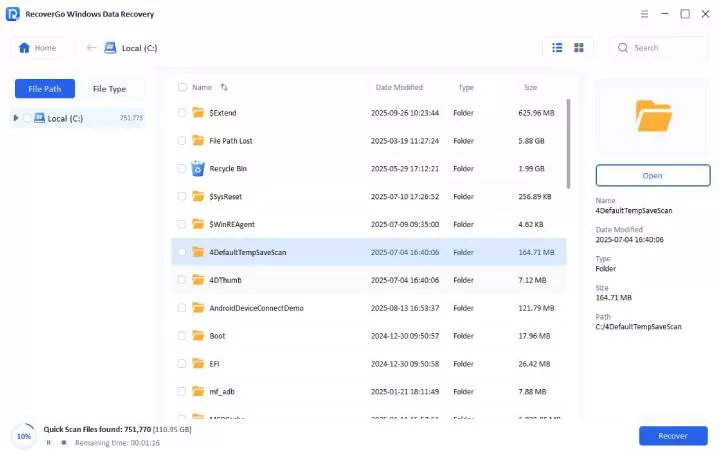
Step 3 Preview the found files and click “Recover.” Choose a safe location (not the source drive) to save your recovered data.

FAQs About PhotoRec
Can PhotoRec recover permanently deleted files?
Yes, PhotoRec can recover permanently deleted files. Even if files are not in the Recycle Bin, the software can still recover them using raw signature scanning.
However, the recovery rate drops in complex data loss scenarios. It works well for simple deletions but may struggle with formatted or RAW drives.
What is the difference between TestDisk and PhotoRec?
Both tools are from the same developer, CGSecurity. They are bundled together in one download.
- TestDisk is mainly used to fix damaged file systems and repair partitions.
- PhotoRec is designed to recover lost or deleted files.
Can beginners use PhotoRec?
PhotoRec is difficult for beginners due to its command-line interface. The lack of mouse support and preview feature makes it challenging for non-technical users. If you want an easy solution, consider a modern tool like RecoverGo instead.
Why do recovered files have generic names in PhotoRec?
PhotoRec uses file signature scanning to recover data. It doesn’t rely on the file system, which means it cannot access the original file names or folder structure. All recovered files are assigned generic names like f12345.jpg. This is a limitation of the signature-based recovery method.
Conclusion
PhotoRec is a reliable and free data recovery option. It can recover data in various data loss scenarios with an average 87.5% recovery rate. The software is completely free and works on multiple operating systems.
However, it’s difficult to use, and recovered files lose original filenames. The command-line interface also increases the chance of mistakes.
A better option is user-friendly software like iToolab RecoverGo Windows Data Recovery. It lets you preview files, has a 99% recovery rate, and recovers files with original filenames. More importantly, it offers a simple 3-step recovery process that anyone can use.