

I had 2 partitions on my 1 TB HDD. I accidentally deleted some files from D:/ partition. Can I use TestDisk software to recover the deleted data?
— From Reddit Community
Questions like these are very common among users looking for a free data recovery tool. TestDisk is often recommended by users in various online communities.
But can you really trust it to recover lost data? Is it the right choice for your data recovery needs?
In this complete TestDisk review, we will look at its features, safety, actual performance, and real user feedback. By the end, you’ll know exactly whether TestDisk is worth your time.

Part 1: TestDisk Overview
TestDisk is a popular tool for fixing structural issues on drives. It is completely free and is mostly used to recover lost partitions. TestDisk does offer an option to undelete files. However, this function is very limited.
Key Features of TestDisk
Supported OS and File System
TestDisk supports legacy and modern Windows versions. This includes everything from Windows NT to Windows 11.
The software also supports common file systems. It can be used with ReFS, NTFS, exFAT, and FAT12/16/32. This means TestDisk can be used on pretty much all storage devices, including both internal and removable storage. The developers have also bundled PhotoRec along with TestDisk.
Partition Recovery
This tool can be used to recover lost partitions and repair corrupted file system structures.
For example, TestDisk can be used to fix a drive that shows up as RAW. It can also be used in cases where the partition table is gone.
It offers the following options:
- Repair boot sectors (FAT32 and NTFS)
- Recover deleted partitions
- Restore ext2/ext3/ext4 superblocks
- Fix corrupted file systems
- Rebuild partition table (GPT, MBR, etc.)
User Interface
The UI of TestDisk is based on the command line. Everything is text-based. There are no clickable menus or any buttons. A user has to use the keyboard to navigate through the different options.
It’s safe to say the UI is the weakest point of TestDisk. For people who are comfortable with a command-line interface, TestDisk can be a decent option. However, for those seeking a beginner-friendly option, it is better to look for an alternative.
Is TestDisk Completely Free?
Yes. TestDisk is free and open-source. It is distributed under the GNU license. This means anyone can download and use it for partition recovery and data recovery. In fact, anyone can also modify the source code if they want.
There’s no trial or any hidden fees for using TestDisk. Being free is one of the key reasons why TestDisk is so famous among the online community.
Is TestDisk Legit?
The software is completely legit and trustworthy. It has been around since 1998 and is developed by CGSecurity. This means anyone can view its source code and confirm its authenticity.
The software is regularly reviewed by the open-source community. So, TestDisk is completely legit and transparent!
Is TestDisk Safe to Use?
We scanned the TestDisk folder with Microsoft Defender. It found no threats upon scanning the 46 files. This means TestDisk is safe to use as it is free from any virus or malware.
The software also operates in read-only mode. What does this mean? The software only reads the data from the drive but doesn’t write anything on it. So, there’s no risk of overwriting when using TestDisk.
Part 2: How to Use TestDisk for Data Recovery?
Let’s take a look at how to use TestDisk for data recovery:
- Unzip the file and then open testdisk_win.exe as an administrator. Choose “Create” and select your storage device. Then click Proceed.
- Select the file system of the drive. TestDisk automatically selects the right file system for you. So, select the suggested option and hit Enter.
- Select the “Advanced” option. Then you have to select a partition, choose “Undelete”. Hit Enter to proceed.
- Wait for TestDisk to scan the selected partition and show a list of recoverable files.
- Go through the list of deleted files. After selecting the files, press C to copy the files.
- Now, select a destination folder to save the recovered files. Once the recovery is complete, choose the Quit option.


Making a mistake while using TestDisk can lead to permanent data loss. Always create a full disk image before using TestDisk. If you’re not comfortable with command-line tools, consider using a modern recovery tool like RecoverGo instead.
Part 3: TestDisk Test Results
We tested TestDisk on a 32 GB flash drive (NTFS) containing recently deleted files. Here are the results:
Scan Time
TestDisk took around 2 hours to scan a 368 GB partition (NTFS). For our 32 GB test drive, the scanning time was around 12 minutes, which is very reasonable for a free tool.
Recovery Results
The software found 1200 files. However, it only recovered 960 files. This puts its recovery rate at 80%. Also, some of the large .mp4 files were partially corrupted.
Test Summary:
Part 4: What Real Users Say About TestDisk?
TestDisk has a 4.3/5.0 rating on G2. The rating on both Trustpilot and Cnet is 4.0/5.0. The average rating of TestDisk across 3 platforms is 4.15/5.0.
What Users Like
- Completely free and open-source
- Excellent for partition recovery
- Lightweight with no installation needed
- Supports all common file systems
What Users Don’t Like
- Command-line interface is very difficult
- No file preview feature
- One wrong move can cause data loss
Real User Reviews:
Sarah Said:
“TestDisk is a powerful tool. It is free and offers many options to recover data. However, the lack of a GUI makes it difficult to use.”
Trevor Said:
“It is great for partition recovery. However, it is not ideal for recovering deleted files. The recovery rate is low and the process is complicated.”
Michael Said:
“It is a great program! It helped me recover data from an old HDD.”
James Said:
“I just wish it was easy to use. It is free but feels too complicated. I had to use other software for data recovery.”
Verdict:
The user feedback reveals TestDisk is a solid free option. However, the lack of a GUI makes it very challenging for everyday users. Also, the file recovery module is very basic and isn’t as advanced as modern tools.
Part 5: Better Alternative to TestDisk🔥
There’s no doubt that TestDisk is very difficult to use. A better alternative to TestDisk is iToolab RecoverGo Windows Data Recovery. It is a modern data recovery software with a user-friendly interface. With this tool, anyone can recover data without requiring command-line skills!
Key Features of iToolab RecoverGo:
- 99% recovery rate: Aim for 99% recovery success through three scan methods.
- 3-step recovery: Simple workflow for beginners.
- User-friendly interface: Modern GUI helps users recover data easily.
- Free preview: You can preview the files before recovery.
- Wide file support: Restore 1000+ file types, such as photos, videos, documents, and audio files.
- Work with 2000+ devices: Such as hard drives, SD cards, USB flash drives, and other storage devices.
How to Use RecoverGo:
Step 1 Launch RecoverGo. Select a drive and click “Search for lost data” to start the scan.

Step 2 The software begins scanning to locate deleted or lost files. Three scan modes can increase the success rate.
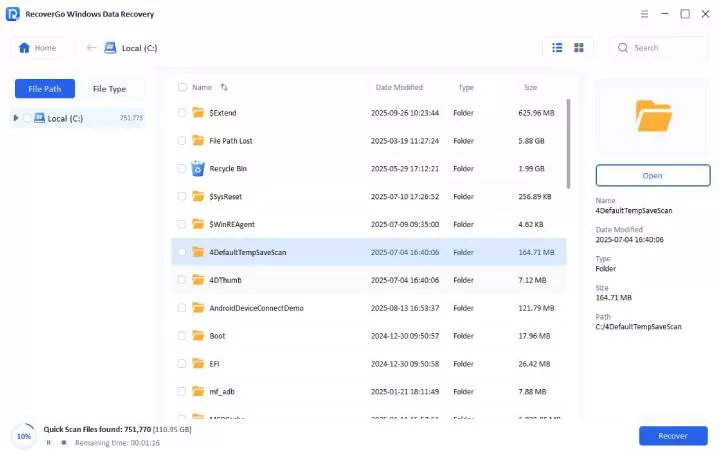
Step 3 Once the scan is complete, you will see a list of all the recoverable files. Preview the files and click “Recover” to restore them.

Final Verdict
TestDisk is an open-source tool with a number of useful features. However, there’s no GUI, and it is definitely not easy to use. Just looking at the command-line interface can drive away most potential users.
Also, making a mistake while using TestDisk can get costly. It is always recommended to make a full disk image before using it.
If your true goal is file recovery, it is better to use modern data recovery software. iToolab RecoverGo Windows Data Recovery is a solid option because of its clean interface and easy workflow. It has a 99% recovery rate, which is way higher than what TestDisk offers. RecoverGo is also better at handling both simple and complex data loss scenarios.